
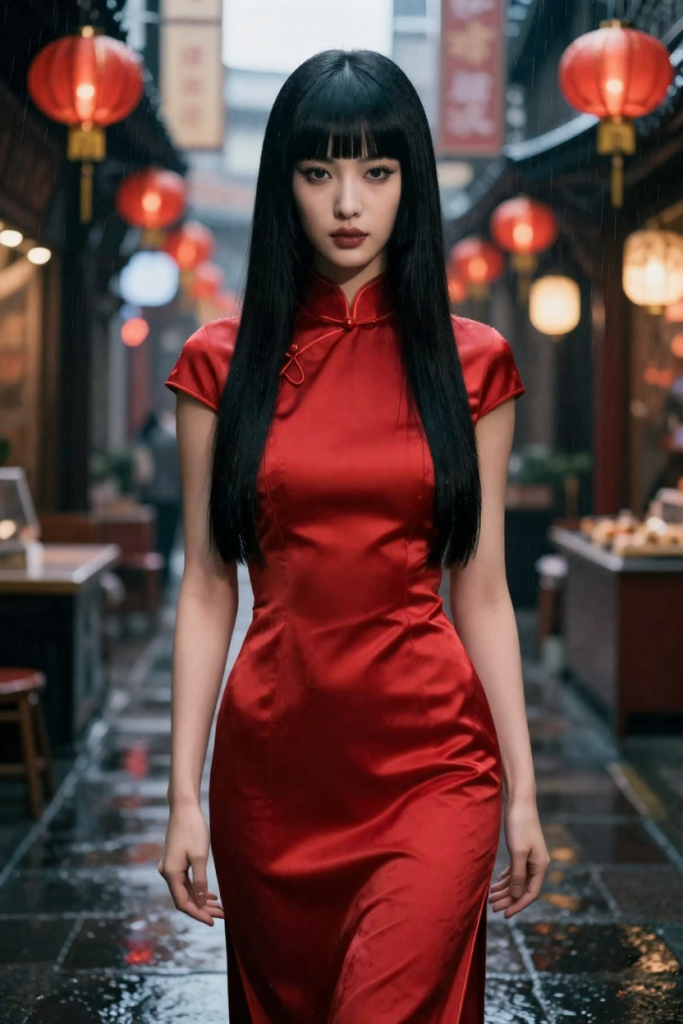
A resident muse earns her keep by being recognised, and recognition is fragile. Move her from the market lane to the harbour steps and everything in the frame changes — light, palette, wardrobe, weather — which is precisely why the description of her must not change at all. Studios that drift do not have a model problem; they have a filing problem. The character gets re-described from memory each session, memory edits, and within a month the feed stars three similar strangers.
Separate the woman from the evening
Write two documents, not one. The muse block holds five anchors in a fixed order — age stated as a number (25 or over), hair, build, one or two durable face details, and a signature item — and it is pasted verbatim at the top of every prompt. The scene lines hold everything else: district, wardrobe, light, pose, weather. Scene lines are supposed to change nightly. The block is not. When a frame comes back off-muse, the diagnosis is mechanical: either a scene line contradicted an anchor (a “short bob” scene fighting the block’s waist-length hair) or an anchor was vague enough to reinterpret — tighten the wording, save the block as a new version, and keep going.
Cast the swaps from the same file
Consistency has a second layer once face swaps enter the workflow. Keep one clean, front-facing, evenly lit portrait as the casting source, and use that same file for stills and video alike. The generator’s muse block and the swap’s source file are two copies of the same decision — the woman, fixed — so a set produced by generation and a set produced by casting still read as one resident of one city.
Version her like you mean it
Characters evolve: a haircut arc, a new signature, a season abroad. Do it deliberately. Save the new block as version two with a date, and keep version one on file so earlier sets remain reproducible. The audience experiences a woman with a life; the studio experiences a changelog. Both are better than drift, which is just change nobody chose.